Carbon is one of the most important elements on Earth. It is the building block of life, and it is found in the atmosphere, ocean, and in the Earth itself.
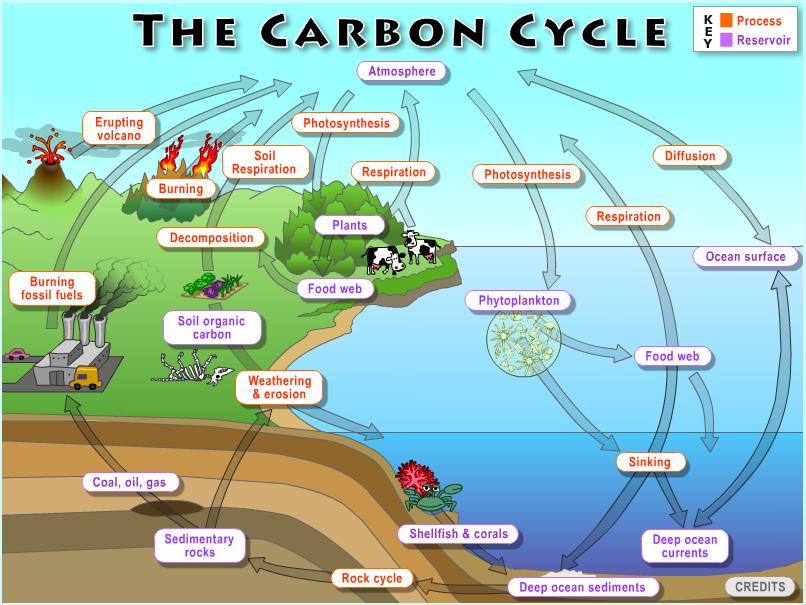
A diagram of the carbon cycle (https://serc.carleton.edu/earthlabs/carbon/lab_2.html)
How the Carbon Cycle Works
Carbon is found in all parts of the Earth and it cycles between them. There are carbon sinks which absorb carbon, and there are carbon sources which release carbon. There are three main carbon sinks: plant life, the ocean, and the soil. Carbon sources include volcanoes, fires, and fossil fuels.
Carbon in the atmosphere is mainly in the form of carbon dioxide. This molecule is made up of one carbon atom bound to two oxygen atoms. In the atmosphere carbon dioxide has an effect on the temperature of the Earth. It is a greenhouse gas, which means that it absorbs the energy from the sun after it reflects off of the Earth’s surface, which traps heat. Without this effect the Earth would be much colder and most of the water would be frozen.
Plants help to regulate the amount of carbon dioxide in the atmosphere by absorbing it so that they can produce their own food. They use the light from the sun and carbon dioxide to build sugars, another type of carbon based molecule. Carbon is also the building block for many other molecules essential to life such as DNA and proteins. The carbon from plants is then spread to animals through the food web. Some animals get their nutrients directly from plants while some consume other animals for theirs. Plants and animals release some carbon dioxide back into the atmosphere during cellular respiration, but this is less than the amount that plants absorb. Through this process carbon is stored inside of living things.
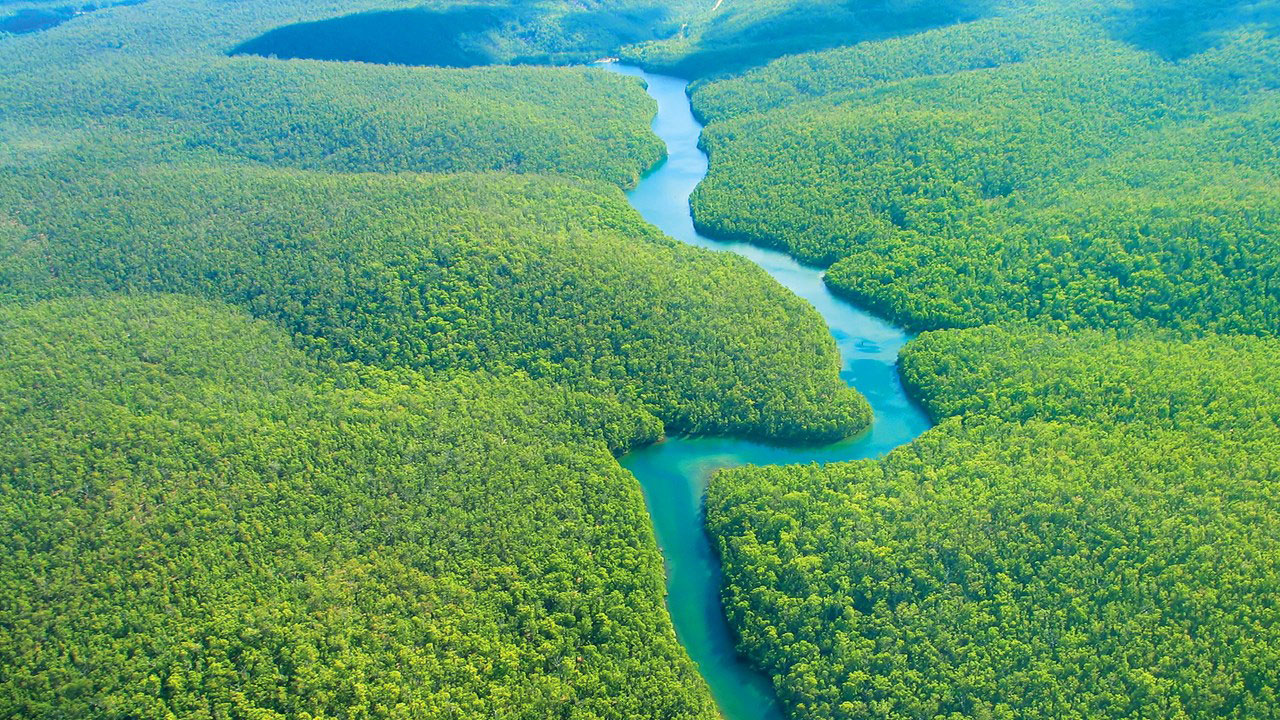
Rainforests, like the Amazon pictured above, are some of the most important carbon sinks in the world. (https://www.theschoolrun.com/homework-help/rainforest-habitats)
The ocean acts as a carbon sink in a few different ways. Phytoplankton are microscopic organisms that live in the ocean and are capable of photosynthesis. Just like plants on land they use carbon dioxide to make their own food, and then supply carbon to the other organisms in the ocean. Carbon dioxide is also exchanged between the atmosphere and the ocean surface. This exchange depends on the amount of carbon dioxide in the air and in the ocean. If there is more carbon dioxide in the air the ocean will absorb some. If there is more in the ocean than carbon dioxide will be released to the atmosphere. The temperature of the ocean also plays a role as cooler waters are able to absorb more carbon dioxide.
Many ocean animals have shells that are made up of calcium carbonate, another carbon based molecule. When these creatures die their shells sink to the bottom of the ocean. After millions of years and a lot of heat and pressure from the Earth these are transformed into limestone. This process traps carbon in the crust of the Earth and prevents it from going back into the atmosphere.
The soil also holds a lot of carbon. Carbon from plant roots and from decaying plants and animals feeds microorganisms in the soil. This causes some carbon to go into the soil, although some of the carbon from decaying plants and animals is also lost to the atmosphere.These decaying plants and animals can also become fossil fuels, like coal and oil, by being buried and subjected to heat and pressure inside of the Earth for hundreds of millions of years. This causes carbon to be locked inside of the Earth and kept out of the carbon cycle for a very long time.
The natural carbon sources are volcanoes and fires. Volcanoes release carbon dioxide that was stored inside of the Earth. Magma from the mantle contains dissolved carbon dioxide and this is released from volcanic vents. Wildfires are also a source of carbon. Combustion breaks down the fuel that is being burnt and releases carbon dioxide. Wildfires generally burn plant matter such as forests or grasslands and release the carbon that was stored inside of the plants.
Humans Effect on the Carbon Cycle
Humanity has affected the way that the carbon cycle works by adding new carbon sources. The largest of these are the burning of fossil fuels. This began during the Industrial Revolution with the use of coal, which was burnt for energy. This was very beneficial to humanity and helped create modern society as we know it. The amount of fossil fuels being used increased over time. Crude oil and natural gas were also exploited. There was a downside from this because the carbon that was locked away in fossil fuels was now released into the atmosphere.
We have also changed the carbon cycle through our use of land. One way that this has happened is through deforestation. One of the most widely used methods for deforestation is called slash and burn. In this method all of the trees are cut down and everything that is left is burned. This releases all of the carbon stored in the forest into the atmosphere. Humans have replaced a vast amount of natural ecosystems around the world with cities and agriculture, which causes the loss of carbon sinks.
Changes in the Carbon Cycle and Climate Change
As mentioned previously, carbon dioxide is a greenhouse gas and traps heat in the atmosphere which warms the planet. Burning fossil fuels has added more greenhouse gases to the atmosphere. Additional greenhouse gases in the atmosphere are causing problems and will continue to in the future. The increase in carbon dioxide has caused the Earth to warm. This is affecting weather around the world and will result in a changed climate. These warmer temperatures cause the loss of glaciers, more intense droughts, increased wildfires, and stronger storms. It will also cause ocean levels to rise from polar melt water entering the ocean and increase coastal flooding and storm surges. These effects can hurt food production and will cause problems for human civilization if we do not switch from fossil fuels to cleaner sources of energy.
References
US Department of Commerce, and National Oceanic and Atmospheric Administration. “What Is the Carbon Cycle?” NOAA’s National Ocean Service, 2 Apr. 2019, oceanservice.noaa.gov/facts/carbon-cycle.html.
“The Carbon Cycle.” Khan Academy, Khan Academy, http://www.khanacademy.org/science/high-school-biology/hs-ecology/hs-biogeochemical-cycles/v/carbon-cycle.
“Volcanoes and the Carbon Cycle.” Interviews | Naked Scientists, http://www.thenakedscientists.com/articles/interviews/volcanoes-and-carbon-cycle.
“What Are Carbon Sinks and What Are Natural and Artificial Carbon Sinks?” Conserve Energy Future, 8 June 2019, http://www.conserve-energy-future.com/carbon-sinks.php.
“Sources & Sinks.” The Environmental Literacy Council, enviroliteracy.org/air-climate-weather/climate/sources-sinks/.
“Climate Science Glossary.” Skeptical Science, skepticalscience.com/volcanoes-and-global-warming.htm.
“The Greenhouse Effect.” The Greenhouse Effect | UCAR Center for Science Education, scied.ucar.edu/longcontent/greenhouse-effect.
Wylie, Robin. “Long Invisible, Research Shows Volcanic CO2 Levels Are Staggering (Op-Ed).” LiveScience, Purch, 15 Oct. 2013, http://www.livescience.com/40451-volcanic-co2-levels-are-staggering.html.
 Science and Nature